
DTF vs Screen Printing: Which Printing Method Is Right for You?
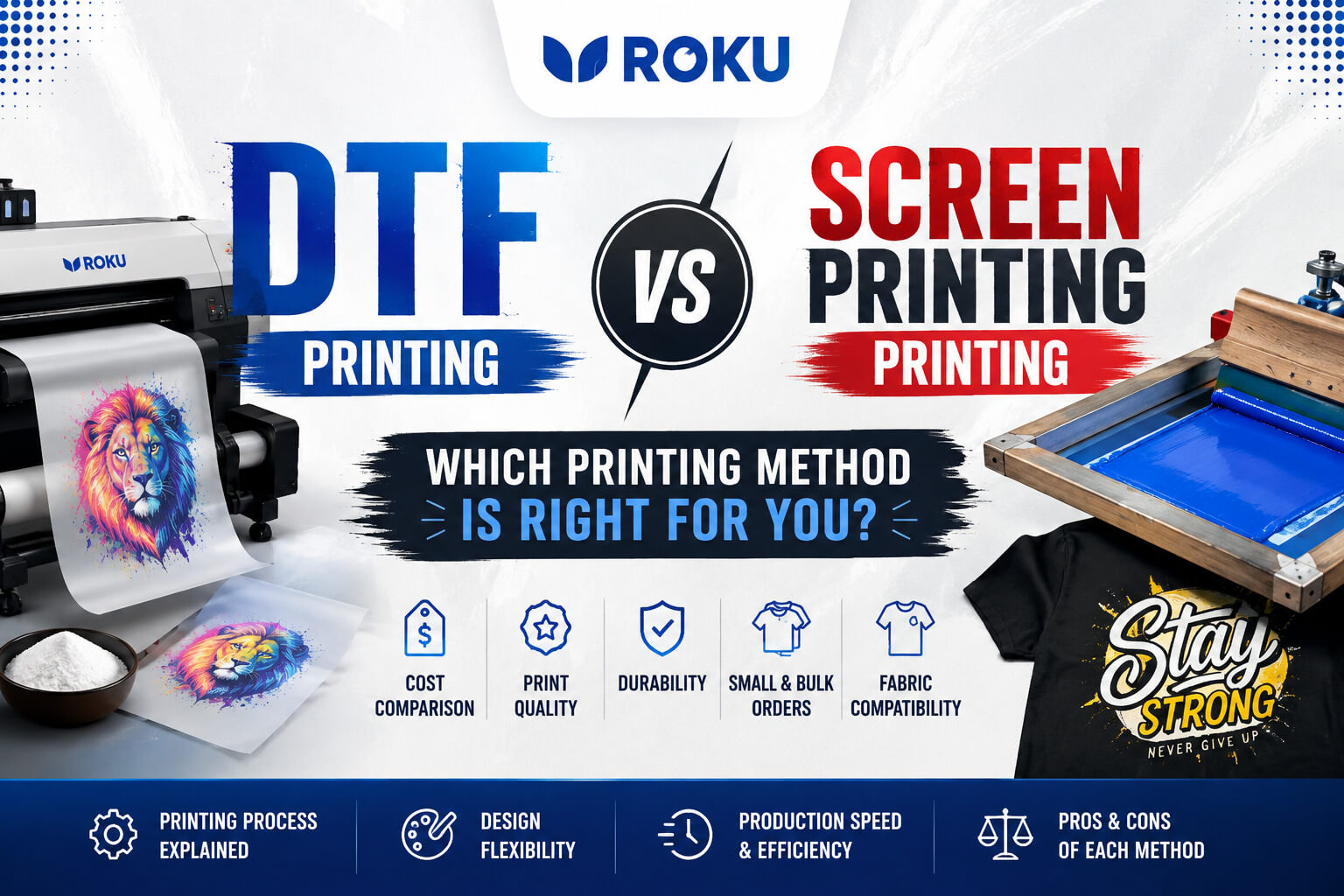
When it comes to custom apparel printing, two popular methods often come into consideration: DTF printing and screen printing. Both methods can produce high-quality prints, but they work differently and are better suited to different types of projects.
If you are printing custom T-shirts, uniforms, promotional apparel, or personalized garments, choosing between DTF and screen printing can affect your costs, production time, print quality, and overall business efficiency.
So, which is better: DTF or screen printing?
The answer depends on factors such as order quantity, design complexity, fabric type, budget, and turnaround time. In this guide, we’ll compare DTF vs screen printing to help you determine which printing method is right for your needs.
What Is DTF Printing?
DTF stands for Direct-to-Film printing. It is a digital printing method where a design is printed onto a special PET film using a DTF printer. The printed design is then coated with hot-melt adhesive powder, cured, and transferred onto the garment using a heat press.
One of the biggest advantages of DTF printing is its flexibility. It can produce detailed, colorful designs without requiring screens or extensive setup.
The typical DTF printing process involves:
- Creating a digital design.
- Printing the design onto DTF transfer film.
- Applying hot-melt adhesive powder.
- Curing the powder.
- Pressing the transfer onto the garment.
- Peeling the film to reveal the finished print.
DTF is suitable for T-shirts, hoodies, uniforms, bags, and many other fabric products. It is particularly useful for businesses that handle custom orders, small batches, personalized garments, and complex artwork.
What Is Screen Printing?
Screen printing is a traditional apparel printing technique that uses a mesh screen to transfer ink onto a garment. A separate screen is generally prepared for each color used in the design.
Ink is pushed through the screen onto the fabric, creating the desired image. The garment is then cured so that the ink bonds properly with the fabric.
Screen printing is well known for producing durable prints and is widely used for large-volume apparel production.
However, the setup process can take more time because screens need to be prepared before printing. As the number of colors increases, the preparation process can also become more complicated.
DTF vs Screen Printing: Key Differences
While both methods can create attractive apparel prints, there are significant differences between DTF and screen printing.
| Factor | DTF Printing | Screen Printing |
| Setup | Minimal setup | More extensive setup |
| Small Orders | Excellent | Less economical |
| Bulk Orders | Good | Excellent |
| Design Complexity | Excellent | More challenging |
| Multiple Colors | Easy | Requires additional screens |
| Personalization | Excellent | Less convenient |
| Fabric Compatibility | Very versatile | Depends on ink and fabric |
| Turnaround Time | Fast | Longer setup |
| Photographic Designs | Excellent | More difficult |
| Cost Efficiency | Strong for small/medium orders | Strong for large orders |
The right choice depends largely on the type and volume of work you handle.
DTF vs Screen Printing: Cost Comparison
Cost is one of the most important factors when selecting a printing method.
With screen printing, the initial setup can involve creating screens, preparing inks, and setting up the printing equipment. This makes screen printing less convenient for very small orders because the setup cost is spread across only a few garments.
DTF printing generally requires less preparation for individual designs. Once the artwork is ready, it can be printed digitally and transferred onto the garment.
For example, if a customer wants five T-shirts with five different designs, DTF can be particularly convenient because you don’t need to prepare separate screens for every design.
For very large orders featuring the same simple design, however, screen printing can become increasingly cost-effective because the initial setup cost is distributed across many garments.
Which Is More Affordable?
- Small orders: DTF is often more economical.
- Personalized orders: DTF is usually more convenient.
- Medium-sized orders: Either method may work depending on the design.
- Large bulk orders: Screen printing can offer a lower cost per garment.
Therefore, there isn’t a single winner when comparing DTF vs screen printing cost. Order size and design requirements play a major role.
DTF vs Screen Printing: Print Quality
Print quality is another important consideration.
DTF printing is particularly strong when designs contain multiple colors, gradients, fine details, photographs, or intricate artwork. Since the design is printed digitally, reproducing complex artwork is relatively straightforward.
Screen printing can also produce excellent-quality prints, particularly when working with bold graphics, logos, typography, and solid colors. Screen-printed designs are known for their strong color coverage and professional appearance.
For highly detailed or photographic artwork, however, DTF generally offers greater flexibility.
If your customers frequently request colorful artwork, detailed illustrations, or personalized graphics, DTF can be a practical option.
DTF vs Screen Printing: Durability
Durability is another area where both methods can perform well when the correct materials and processes are used.
Screen printing has a long-standing reputation for producing durable apparel prints. With proper curing and quality inks, screen-printed designs can withstand repeated washing and everyday use.
DTF prints can also be highly durable when quality film, ink, adhesive powder, and appropriate heat-press settings are used. Proper garment care can further extend the life of the print.
The durability of either method depends on factors such as:
- Ink or transfer quality
- Fabric type
- Curing or heat-press settings
- Print application
- Washing and drying conditions
- Garment quality
Instead of choosing a printing method based only on durability, consider the complete production process and the requirements of the finished product.
Which Is Better for Small Orders?
If you regularly receive small or customized orders, DTF printing has a significant advantage.
Suppose a customer wants only three T-shirts, each featuring a different design. With DTF, you can print the designs digitally without going through the screen preparation process required by traditional screen printing.
This makes DTF suitable for:
- Custom T-shirts
- Personalized apparel
- Small business orders
- Event merchandise
- One-off designs
- Names and numbers
- Print-on-demand businesses
For businesses that don’t want to maintain large inventories or only produce garments after receiving an order, DTF can provide considerable flexibility.
Which Is Better for Bulk Orders?
Screen printing can be particularly effective for large orders where the same design needs to be printed across hundreds or thousands of garments.
Once the screens are prepared, the production process can be repeated efficiently. This can reduce the cost per garment as the order volume increases.
For example, a company ordering 500 T-shirts with the same simple logo may find screen printing more cost-effective than DTF.
However, DTF can still be useful for bulk orders when designs are complex, highly detailed, or different from one garment to another.
DTF vs Screen Printing for Different Designs
The type of artwork you print should also influence your decision.
Simple Logos
Screen printing can be an excellent choice for simple logos with a limited number of colors, especially when ordering large quantities.
Complex Graphics
DTF is generally more convenient for detailed graphics containing multiple colors, gradients, and fine elements.
Photographic Designs
DTF is particularly suitable for reproducing photographic images and detailed digital artwork.
Personalized Designs
For names, numbers, individual graphics, and other personalized designs, DTF offers significant flexibility because each design can be digitally changed before printing.
DTF vs Screen Printing: Fabric Compatibility
DTF printing can work across a wide range of garments and fabric types when the appropriate materials and application settings are used. This makes it attractive to businesses that print on different types of apparel.
Screen printing is also highly versatile, but the type of ink and printing process may need to be selected according to the fabric.
If your business handles different garments and materials, DTF can provide a convenient digital workflow without requiring a completely different screen setup for every design.
Pros and Cons of DTF Printing
Pros
- Excellent for small orders
- Minimal design setup
- Suitable for complex artwork
- Excellent color reproduction
- Great for personalization
- Suitable for print-on-demand businesses
- Fast design changes
- Can work with various garment types
Cons
- Requires a DTF printer and related equipment
- Consumable costs need to be managed
- Requires proper film, powder, ink, and heat-press settings
- Large simple bulk orders may be more economical with screen printing
Pros and Cons of Screen Printing
Pros
- Excellent for large-volume orders
- Durable prints
- Effective for simple, bold designs
- Can provide a competitive cost per garment at high volumes
- Well-established production method
Cons
- More setup is required
- Multiple colors require additional screens
- Less convenient for individual personalization
- Small orders can be less economical
- Complex designs can require more preparation
DTF or Screen Printing: Which One Should You Choose?
There is no universal answer to which printing method is better. Your ideal choice depends on what you print and how your business operates.
Choose DTF printing if you:
- Handle small or medium-sized orders
- Print highly detailed designs
- Need multiple colors or gradients
- Offer personalized T-shirts
- Produce print-on-demand apparel
- Need flexibility and quick design changes
Choose screen printing if you:
- Handle large-volume orders
- Frequently print the same design
- Work primarily with simple graphics
- Want to optimize the cost per garment for bulk production
- Have an established screen-printing workflow
For some apparel businesses, the best solution may even be to use both methods. DTF can handle personalized and smaller orders, while screen printing can be used for large-volume jobs.
DTF vs Screen Printing for Your Printing Business
If you’re starting or expanding an apparel printing business, think beyond the printing method itself.
Consider your typical order size, customer requirements, available workspace, equipment investment, production capacity, and the types of designs you expect to print.
A DTF printer can be particularly attractive for businesses that want to offer customized apparel without maintaining extensive screen setups. It can also make it easier to accept small orders and experiment with different designs.
Screen printing, on the other hand, can remain highly effective for businesses focused on high-volume production.
The best approach is to choose equipment and a printing process based on your actual customer demand rather than simply following a general industry trend.
Frequently Asked Questions
Is DTF printing better than screen printing?
DTF can be better for detailed designs, small orders, personalization, and flexible production. Screen printing can be better for large-volume orders with simple designs.
Is DTF cheaper than screen printing?
DTF can be more cost-effective for small orders because it requires less setup. Screen printing can become more economical for large-volume orders.
Which lasts longer, DTF or screen printing?
Both can provide durable results when the correct materials and production processes are used. Proper application and garment care have a major impact on print longevity.
Is DTF better for small orders?
Yes. DTF is particularly well suited to small orders because designs can be printed digitally without extensive screen preparation.
Is screen printing better for bulk orders?
For large quantities of the same design, screen printing can be highly efficient and cost-effective.
Can DTF print more detailed designs than screen printing?
DTF is generally more convenient for highly detailed, multi-color, gradient, and photographic designs.
Which printing method is better for starting a T-shirt business?
DTF can be a practical choice for a new T-shirt business focused on customized, small-batch, and print-on-demand orders. However, the right choice depends on your target customers and expected order volume
Final Verdict: DTF vs Screen Printing
So, DTF vs screen printing—which printing method is right for you?
If flexibility, personalization, detailed designs, and small-batch production are important to your business, DTF printing can be an excellent choice.
If your primary focus is large-volume production with the same simple designs, screen printing may provide better production efficiency and cost advantages.
Ultimately, the best printing method depends on your order quantity, design complexity, budget, fabric requirements, and production goals.
Understanding these differences will help you choose the right technology for your apparel printing business and deliver the quality and value your customers expect.

Celebrating over two decades of manufacturing excellence in China, Roku Prints is a global leader in delivering cutting-edge printers, including our state-of-the-art DTF printers…
Quick Links
Products
- DTF PrintersDirect-to-Film (DTF) printing is a super popular method for creating high-quality, full-color transfers that can be applied to shirts and other garments. If you’re looking for a DTF printing machine for shirts, here’s a quick rundown of what to consider, plus some top options to check out in 2025.
- UV Printers
- DTF Accessories
- Printing Solutions
- Sublimation Printers
Contact Information
 Noida Rd, E-07, Basement floor, Noida, Uttar Pradesh 201301
 +91-9560108015, 9560028016, 9212382730
 info@rokuprints.com
Copyright © 2026 Roku prints. All Rights Reserved.